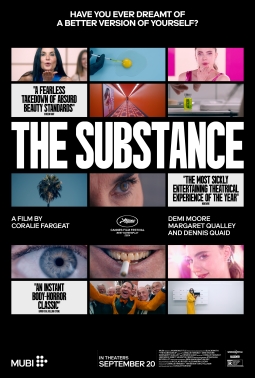

The Substance is a 2024 body horror film written and directed by Coralie Fargeat. It follows a fading celebrity (Demi Moore) who is fired by her producer (Dennis Quaid) due to her age and uses a black market drug that creates a younger version of herself (Margaret Qualley) with unexpected side effects.
Fargeat wrote the screenplay to explore societal pressures surrounding women's bodies and aging. Principal photography took place in France from August to October 2022. The film is noted for its use of satire and grotesque, hyperrealistic imagery, accomplished through prosthetic makeup and other practical effects, including bodysuits, puppetry, dummies, and approximately 21,000 liters (5,500 U.S. gallons) of theatrical blood. Originally set for distribution by Universal Pictures, the rights were later acquired by Mubi after a dispute between Fargeat and Universal over final cut privilege.
The Substance premiered at the 77th Cannes Film Festival on May 19, 2024, where it won Best Screenplay and was nominated for the Palme d'Or. The film was theatrically released in the United Kingdom and the United States on September 20, 2024, and in France on November 6, 2024. It received widespread acclaim, with particular praise for Fargeat's writing and directing, the special effects, and Moore's performance. At the box office, the film grossed $77–82 million on a budget of $18 million, becoming Mubi's highest-grossing film. Moore's performance earned her a Golden Globe Award, Critics' Choice Award, and Screen Actors Guild Award, as well as nominations for an Academy Award and BAFTA Award. The film also received nominations for Best Picture and Best Director at the Academy Awards, Critics' Choice and Golden Globes.
Plot
On her 50th birthday, faded Hollywood film star Elisabeth Sparkle is dismissed from her long-running aerobics TV show by its producer, Harvey, due to her age. Elisabeth crashes her car while distracted by a billboard of herself being taken down. At the hospital, a young male nurse gives her a flash drive advertising "The Substance", a black market drug that promises a "younger, more beautiful, more perfect" version of oneself.
Elisabeth orders The Substance and injects the single-use serum. She convulses as a younger woman named Sue emerges from a slit in her back. The two bodies must switch consciousness once every week, with the inactive body remaining unconscious and fed intravenously. Daily injections of stabilizer fluid, extracted from the original body, are required to prevent Sue from deteriorating. Sue becomes an overnight sensation after auditioning as Elisabeth's replacement, and Harvey offers her the chance to host the New Year's Eve show. While Sue lives a confident and hedonistic life, Elisabeth becomes a self-hating recluse. Near the end of one weekly cycle, Sue brings a man home for casual sex; she delays the switch by extracting additional stabilizer fluid, causing Elisabeth's right index finger to rapidly age. Elisabeth contacts the supplier, who warns that delaying the switching schedule will lead to irreversible, rapid aging of the original body.
Elisabeth and Sue gradually become separate personalities and begin to hate each other. Elisabeth resents Sue's frequent disregard of the switching schedule, causing further aging, while Sue is appalled by Elisabeth's descent into unhealthy binge-eating. Following a particularly destructive episode, Sue stockpiles stabilizer fluid and refuses to switch back. Three months later, on the day before the New Year's Eve show, Sue runs out of stabilizer fluid and contacts the supplier, who informs her she must switch back to replenish the fluid. When they switch, Elisabeth finds herself transformed into a deformed, hag-like hunchback. To stop Sue aging her further, Elisabeth orders a serum designed to terminate her. However, Elisabeth, still craving Sue's celebrity status, stops before fully injecting the serum and resuscitates Sue, leaving both of them conscious. Realizing Elisabeth's initial intent, Sue beats Elisabeth to death before leaving to host the show.
Without Elisabeth, and due to most of the serum already being injected, Sue's body rapidly deteriorates. She attempts to create a new version of herself using the leftover serum, despite the single-use warning. This results in the creation of a grotesque mutated body, "Monstro Elisasue", with both Elisabeth's and Sue's faces. Wearing a mask cut from a poster of Elisabeth, Monstro Elisasue attempts to host the show, but the audience erupts into chaos. An audience member decapitates her, only for an even more mutated head to grow back, and one of her arms to break and drench the audience and studio in blood.
Fleeing the studio, Monstro Elisasue collapses and explodes into viscera. Elisabeth's original face detaches from the gore, crawling onto her neglected star on the Hollywood Walk of Fame. She smiles as she hallucinates being admired before melting into a puddle of blood, which is cleaned up by a sidewalk scrubber the next day.
Production
The Substance was an international co-production between France, the United Kingdom and the United States. Coralie Fargeat was director and producer alongside Working Title Films co-producers Eric Fellner and Tim Bevan, and Blacksmith, a Paris-based production company created by Fargeat that same year. Filming began on May 9, 2022, and wrapped in October 2022, spanning 108 shooting days. The film's budget was $17.5-18 million. The project took five years from concept to release.
Casting
Fargeat knew that casting would be challenging, as the film features minimal dialogue and relies heavily on the characters. Elisabeth Sparkle needed to be cast first, given that she was the center of the film's narrative. Fargeat wanted to cast an actress who had been at the heart of the star system, a real-life icon. Fargeat did not include Demi Moore on the initial list of potential lead actresses, stating 'She will never do it'; several actresses were considered but declined the role before Moore. Eventually, with nothing to lose, Moore was sent the script.
At her agent's insistence, Moore read the script before knowing specific details, later speculating that this was due to the film's sensitive subject of aging. She was impressed by the script and its subject matter, though she was unfamiliar with the body horror genre. Moore felt that the film could either "really work and be part of a cultural shift" or "be a fucking disaster". She remained unsure of the audience reaction up until the premiere when she knew the film had worked.
Surprised by Moore's positive response, Fargeat read her autobiography and was struck by her resilience. "I read her autobiography, and she had some tough years in her personal life. [...] She made herself on her own [...] in a place that was a totally male-dominated industry, being ahead of her time in many regards, like doing this naked picture of her pregnant, taking a lot of risks and having a lot of feminist statements, wanting to be paid as much as her co-stars". Fargeat had previously worked as a trainee assistant director on the Moore-led film Passion of Mind (2000), handling tasks like making copies and bringing her coffee in the mornings.
Before being offered the role, Moore discussed the film with Fargeat over six meetings. Fargeat explained the film in detail: the film's extensive prep work, prosthetics, meager resources, shooting location and the level of nudity, which she felt was foundational to the story.
Moore understood the meta-nature of the role but did not feel that she was the character, as Elisabeth had no family. As she further explained, "she's dedicated her entire life to her career, and when that's taken, what does she have?" However, Moore sympathized with the character's pain. She recognized that the characters were deeply important to Fargeat, and saw them as stand-ins for the director herself: Elisabeth represents Fargeat, while Qualley's Sue is the girl from the '90s that Fargeat always felt pitted against. Moore would later reflect positively on her role, saying, "What I love is this was a rich, complex, demanding role that gave me an opportunity to really push myself outside of my comfort zone, and in the end to feel like I explored and grew not only as an actor, but as a person".
While talking to Moore, Fargeat thought about potential pairings; later, when she met with Margaret Qualley, she felt they had a common energy. Fargeat liked that Qualley had a background as a dancer. Moore had prior indirect ties with Qualley and worked with Qualley's mother Andie MacDowell in St. Elmo's Fire (1985), while Qualley knew Moore's daughters.
Qualley was in Panama, shooting Claire Denis's Stars at Noon (2022), when she read the script and was drawn to the prospect of playing a character who seemed "really far from [her]" and she had a feeling that it was going to be "special". During prep, Fargeat emphasized the physicality of the roles (both actors' bodies would be central to their performances). For Qualley, this meant lifting weights for months to achieve Sue's sex symbol figure. Qualley spent a lot of time walking around her apartment practicing her character, "freaking my husband out".
Ray Liotta was originally cast as Harvey, but died in May 2022. Three months into filming, Liotta was replaced by Dennis Quaid.
On set, Fargeat read the dialogue for the Substance Voice to provide a temporary track. After a lengthy casting process, she chose American actor Yann Bean, who was living in Paris, to voice it. Fargeat wanted a voice with devil-like, tempting, and powerful qualities.
Filming
Principal photography took place entirely in France, with an all-French film crew except for cinematographer Benjamin Kračun and composer Raffertie (both from the United Kingdom). Studio scenes were filmed at Epinay Studios in Seine-Saint-Denis, Île-de-France near Paris—the historic studio where Jean Cocteau shot Beauty and the Beast (1946). Exterior scenes doubling for Los Angeles were filmed on the Côte d'Azur, including locations in Antibes such as the Anthéa Theatre, which doubled for a hospital, and the Marineland parking lot. Palm trees were filmed in Cannes with additional scenes shot in Nice, Carros and Saint-Laurent-du-Var. France was selected to accommodate the film's extensive shooting schedule due to practical effects work, with the country's 40% Tax Rebate for International Productions (TRIP) providing an additional incentive.
Fargeat selected Kračun as cinematographer after being impressed by his work on Promising Young Woman (2020). He shot the film primarily with the Alexa LF, for its accurate capture of skin tones, and used vintage, spherical Canon K35 lenses to accommodate the large number of close-ups in the film. Other lenses included Angénieux Optimo zooms, Leitz Thalia, macros from Cooke Optics and Arri and a Leitz M 0.8 for the body-camera work. Red V-Raptor and Komodo were also used: the former for visual effects, with its high resolution 8K sensor, and the latter for the body, requiring a helmet rig.
The film was shot in continuity when possible, adopting what the crew called a "lab shoot" approach in its final month. The "lab shoot" was used to capture insert shots, typically assigned to a second unit with a reduced crew. The most time-consuming prosthetics shots were filmed during this time period, including close-ups of injections and a back splitting open. Fargeat storyboarded all the prosthetics and birth sections before production began, focusing on the birth scene first during pre-production. This helped estimate financial costs for the prosthetic dummies, how many to build, and the extent of their body details. The birth sequence took 15 days to film. Fargeat even went so far as to perform an actual syringe injection of the activator on her own arm, doubling for Demi Moore in the shot. Crew sizes fluctuated significantly throughout production, ranging from just 6 members for the lab shoot, 8 for exterior scenes, and over 200 for complex practical effects sequences in the studio.
Kračun initially considered using a safety wire to drop a camera past a series of lights for the infinity tunnel sequence. Ultimately, he devised a simpler solution: two horizontal bicycle tires surrounded by LED tube lights, spinning together at the same speed around a stationary camera to create an infinity tunnel effect. He decided to film the fire in the shape of a dragon on the studio floor practically, capturing it from above. The footage was then blended into the scene where Sue is seen by the window.
For his lunch scene with Demi Moore, Quaid consumed approximately 2 kilograms (4.4 lb) of shrimp.
Margaret Qualley lightheartedly described learning the choreography for The Substance as a "nightmare" and was overwhelmed by performing with professional dancers who had already memorized the moves which she was new to. Although trained as a ballet dancer, she explained that "that specific kind of sexuality doesn't lend itself to [me]" and that she'd "never [do it] again". Qualley began the rehearsal with Fargeat present but left the set to go to the bathroom and cry. Fargeat decided to leave the rehearsal as well; Qualley instead chose to learn the moves in a private lesson, allowing her to practice in her hotel room and build confidence as she felt deeply ashamed by the whole series of events. Nonetheless, on the day of the shoot, her anxiety led her to get "wasted first thing in the morning" by smoking cannabis and drinking tequila. In a live Q&A after the film's release, Qualley expressed happiness in getting to perform the dance, as many previous scenes had been slow-paced and required minimal movement or expression, making the dance sequence a welcome change.
Moore found Fargeat to be a "very visual director" with a focus on symbolism. While Moore was accustomed to starting scenes with wide shots to establish the scene's space, Fargeat instead began with close-ups. Moore found that "the actor's part of it is not as ... important" to Fargeat: "it's not necessarily where she's as focused". Moore described this as "not good or bad, just kind of different". Fargeat praised Moore's body language in the film; Moore chose to express Elisabeth through subtleties, such as her eyes and other simple expressions. She worked with a movement coach over Zoom for her character's later scenes, where she is forced to move quickly while hunched over due to physical disfigurement.
During a one-week break while only Qualley was working, Moore contracted shingles and lost 20 pounds (9.1 kg) during the production.
Initially, two days of exterior shooting were planned in Los Angeles. However, after Kračun filmed test shots of palm trees early on during filming, Fargeat realized she could use these shots as tableaux, and eliminate extensive exterior shots. Ultimately, the only part of the film actually shot in Los Angeles was the still backdrop (photographed by Rosco Digital) in the Canyons.
Filming of the theater scenes took nearly three weeks. The special effects team utilized around 21,000 litres (5,500 US gal) of fake blood and a fire hose. The shots of the audience being sprayed with blood in the climax were achieved in one take. Kračun was surprised by the amount of blood remarking, "Coralie said at one point, 'I want to have fire engines full of blood spraying the audience,' and I thought, 'Oh, maybe that's just a French way of saying there's going to be a lot of blood,' but no, she really wanted a hose full of blood in the audience, in the theater, and it was going to be a lot of blood!" It became a significant technical challenge of how to control the spread, pressure, and quantity of blood, how to waterproof the filming equipment, and how to keep everyone safe. Showers were set up outside the theater set for the extras. During the shoot, Kračun hid himself in the audience and filmed while Fargeat operated another camera and controlled the hose. Once Fargeat and Kračun were on set covered in blood, they hugged each other and said, "We did it."
Post-production
Fargeat described post-production as the most challenging period of the production, taking a year and a half. With over 300 hours of dailies, one of the main challenges was finding the right pacing for scenes with little dialogue. Scenes were frequently changed based on the interaction of the music, visual effects and sound design, with post-production finishing just three days before the premiere. Visual effects by NOID Studio took one year to complete.
The film was edited by Jérôme Eltabet, Fargeat, and Valentin Feron. Eltabet had previously collaborated with Fargeat on Revenge and taught her editing while working her children's show Les Fées Cloches He began editing midway through the shoot, approximately three months in and independently created the film's initial 3.5 hour rough cut, which did not include many of the inserts or closeups. After filming wrapped, Eltabet and Fargeat collaborated over six months bringing the runtime to 4.5 hours. Eltabet and Fargeat collaborated by editing separate sequences in different rooms using Adobe Premiere Pro, then swapping the sequences between each other for further refinement. Due to the film's numerous iterations with some sequences having between 150 and 200 different versions, Feron was later brought in to give a new, outside perspective to the film. Several scenes with Elisabeth's agent were shot but ultimately not included as they were not deemed compelling according to Eltabet. He found the theater climax the most difficult to cut, as he had to edit around prosthetics that did not always look convincing.
For the sound design, Fargeat placed sound effects and notes in the editing software timeline for sound designers and editors Valérie Deloof and Victor Fleurant. The team was tasked with finding the right textures, effects, and tone for each scene, using exaggerated or realistic sounds to explore deeper meanings. For example, a chainsaw was used for the electric mixer in Elisabeth Sparkle's cooking scene, and pistol handling sounds were used for the triggering of the capsule during injection shots.
For the first person view shots in the birth sequence, Fargeat wanted Sue's movements to sound as if immersed in amniotic fluid. To achieve this, the sound team placed microphone capsules in the actors' ears to capture breathing through cranial resonance. Simultaneously, a boom mic and a high-frequency mic captured audio to allow for further edits or to switch to an external viewpoint.
For scenes with Harvey, the team wanted to emphasize his larger-than-life character. Before entering a scene like the bathroom or restaurant, sounds were mixed realistically. Once on screen, they became heightened; for example, for the restaurant, sounds were layered emphasizing his eating and the juiciness of the shrimp. Ambient sounds and music in the restaurant were muted at this point. When Harvey enters his office, the sound team emphasized the "blinged-out heaviness" of his boots.
The team created soundscapes to enhance the film's visuals and themes. When Elisabeth leaves to retrieve the substance, the sound design shifts from a noisy street to deserted suburbs with dogs, police sirens, and crows used to foreshadow danger. Inside the storage facility, sounds were shaped musically with metallic materials and sustained notes to give a feeling of discomfort, and then drawn back to only a low and clinical neon light.
For the low-angle shot of "Gollum" banging on the bathroom door, visual effects were used to combine Moore's prosthetics with the prosthetics on the thinner body double.
When projected for Kračun, the film appeared too sharp, so it was downscaled to 2K and then upscaled to 4K to retain the softness he found on the set. When Sue is on the TV show, the footage was kept at the original pre-processed 4K for a sharper look.
Music
The film score was conceived by British producer and composer Raffertie, who became involved late into the post-production around January 2024. He was given only a few months to complete the score. As per Fargeat's interest, Raffertie produced an electronic score that focused on the duality between Elisabeth and Sue, ranging from organic and nostalgic, to synthetic and contemporary.
Release
The Substance was selected to compete for the Palme d'Or at the 2024 Cannes Film Festival, where it had its world premiere on May 19, 2024. The film received a standing ovation. It had its second premiere at the Sydney Film Festival on June 16, 2024, followed by other premieres including the Karlovy Vary International Film Festival, the Toronto International Film Festival, the Munich International Film Festival, the Odesa International Film Festival, the New Horizons Film Festival, and the Edinburgh International Film Festival.
Working Title's parent company, Universal Pictures, which originally signed on as the distributor through a deal with Working Title Films, stepped away from the project but remained credited as a copyright holder in the film's credits. Multiple sources told The Hollywood Reporter that the studio was "worried about the prospect of releasing the film." According to Fargeat, the film encountered significant challenges during post-production, including a contentious test screening attended by two unnamed male executives and one unnamed female representative from Universal. One male executive vehemently opposed the film and insisted on a recut, a demand deemed unfeasible due to Fargeat's contractual final cut privilege. This led to Universal breaking off their distribution deal with Fargeat. Although the female representative later expressed her support for the film privately to Fargeat, she felt unable to voice her opinion during the screening.
Prior to its Cannes debut, Mubi acquired worldwide rights to the film for $12.5–15 million, planning to distribute it theatrically in North America, United Kingdom, Ireland, Germany, Austria, Latin America, Benelux as well as holding rights for Turkey and India, with its sales company subsidiary The Match Factory handling worldwide sales. The Substance opened in theaters in the US, UK, Latin America, Germany, Canada, and Netherlands on September 20, 2024, as well as in Spain on October 11, 2024. Metropolitan Filmexport acquired French distribution rights from The Match Factory, and released the film on November 6, 2024.
Advertising and film distribution costs for The Substance were under $20M worldwide and in the single digits in the United States. The marketing used avant-garde imagery such as a chicken bone and shiny hot pink exercise leotard and was overseen by Fargeat. The only vestige of Moore was a one sheet showing her stitched up back. Despite this unconventional approach, the film spread on social media. Demi Moore's posts reached her 15M followers and contributed to a total online reach of 45M across platforms, as estimated by RelishMix (including 7.6M views on TikTok, 10.8M on Instagram, and millions of views for other fan made content).
The film returned to theaters in the United States on January 17, 2025, as part of its awards season campaign, a few days before the announcement of the nominees for the 97th Academy Awards on January 23.
Box office
The Substance grossed $17.6 million in the United States and Canada, and $59.7 million in other territories, for a worldwide total reported between $77.3 and $82 million.
In the United States and Canada, The Substance was released alongside Transformers One and Never Let Go, and was projected to gross around $3 million from 1,949 theaters in its opening weekend. The film made $1.3 million on its first day, including $512,000 from Wednesday and Thursday night previews. It went on to debut to $3.2 million, finishing sixth at the box office. The film dropped only 39% the following weekend, grossing $1.8 million. The film has become Mubi's highest-grossing film, surpassing the $10 million gross of Priscilla (2023). Additionally, in its first week of PVOD release, it ranked #3 on iTunes and #6 on Fandango at Home.
Critical response
On the review aggregator website Rotten Tomatoes, 89% of 378 critics' reviews are positive, with an average rating of 8.1/10. The website's consensus reads: "Audaciously gross, wickedly clever, and possibly Demi Moore's finest hour, The Substance is a gasp-inducing feat from writer-director Coralie Fargeat." Metacritic, which uses a weighted average, assigned the film a score of 78 out of 100, based on 57 critics, indicating "generally favorable" reviews. On AlloCiné, the film received an average rating of 3.6 out of 5, based on 39 reviews, from French critics. Audiences polled by CinemaScore gave the film an average grade of "B" on an A+ to F scale, while those surveyed by PostTrak gave it an 80% overall positive score (including an average of 4 out of 5 stars), with 75% saying they would definitely recommend it.
Peter Bradshaw's four-star (out of five) review in The Guardian called it "a cheerfully silly and outrageously indulgent piece of gonzo body-horror comedy." David Ehrlich of IndieWire graded the film an A, calling it "an epic, audacious body horror masterpiece ... an instant classic. The most sickly entertaining theatrical experience of the year." Nicholas Barber of the BBC awarded the film four stars out of five, while singling out Moore's performance, writing: "Ripping into her best big-screen role in decades, Demi Moore is fearless in parodying her public image." Phil de Semlyen's five star (out of five) review in Time Out said it is "Moore who glues it all together, going full Isabelle Adjani-in-Possession in a vanity-free performance full of bruised ego, dawning horror and vulnerability."
Owen Gleiberman of Variety praised the film's director, writing: "Coralie Fargeat works with the flair of a grindhouse Kubrick in a weirdly fun, cathartically grotesque fusion of Dr. Jekyll and Mr. Hyde and Showgirls." Radhika Seth of Vogue called it an "audacious piece of filmmaking ... the most exciting release to have debuted on the Croisette so far" and that it was her "current pick to win the Palme d'Or." Damon Wise of Deadline said it is "a riotous, dreamlike horror-thriller that ends in a delirious symphony of blood, guts and otherwise undefinable viscera." Javier Ocaña of El País wrote that the film "is not that great", partly "because subtlety is not Fargeat's greatest virtue", but "mostly because the first 45 minutes seem like a covert remake" of John Frankenheimer's [superior] Seconds.
Filmmakers Ana Lily Amirpour, Edward Berger, Davy Chou, Kelly Fremon Craig, Robert Eggers, Adam Elliot, Hannah Fidell, Michael Gracey, Kitty Green, Laurel Parmet, Rich Peppiatt and Juel Taylor cited it as among their favorite films of 2024.
In June 2025, IndieWire ranked the film at number 91 on its list of "The 100 Best Movies of the 2020s (So Far)." In July 2025, it was one of the films voted for the "Readers' Choice" edition of The New York Times' list of "The 100 Best Movies of the 21st Century," finishing at number 126.
Accolades
The Substance has won a number of awards. At the 77th Cannes Film Festival, Fargeat won Best Screenplay. It competed for the Palme d'Or, losing to Anora. At the 32nd International Film Festival of the Art of Cinematography Camerimage, Director's Debuts Competition, Benjamin Kračun was nominated for cinematography. However, the film was pulled from competition by Fargeat due to negative comments about women in film by the festival director Marek Zydowicz.
At the 82nd Golden Globe Awards, the film received five nominations: Best Motion Picture – Musical or Comedy, Best Director for Fargeat, Best Actress in a Motion Picture – Musical or Comedy for Moore, Best Supporting Actress – Motion Picture for Qualley, and Best Screenplay for Fargeat; Moore won in her category. She additionally won Outstanding Performance by a Female Actor in a Leading Role in a Motion Picture at the 31st Screen Actors Guild Awards.
At the 97th Academy Awards, The Substance was nominated for five awards and won Best Makeup and Hairstyling. It was nominated for Best Picture, Best Original Screenplay and Best Director for Fargeat, and Best Actress for Moore. Fargeat became the first woman to be nominated for writing and directing a horror film, and the ninth woman to be nominated for directing overall in Academy Awards history.